Recruiters are leaving LinkedIn Recruiter because it costs too much, reaches too few candidates, and automates too little. A single Corporate seat runs $8,999-$10,800 per year according to buyer-reported data compiled by HootRecruit (2026), while the average InMail response rate across all campaigns sits at just 6.38% per EngageKit's 2025 benchmark study. The platform still restricts outreach to a single channel (InMail), bans automation, and raises prices roughly 15% every year. Meanwhile, AI sourcing tools that search 850M+ profiles and automate multi-channel outreach for a fraction of the price are pulling recruiters away faster than LinkedIn can add features.
This isn't a temporary blip. LinkedIn itself acknowledged "shifts in customer behavior and slower revenue growth" in May 2025, according to Industry Leaders Magazine. The company followed that admission with 281 layoffs in its engineering and recruiting divisions. AI adoption in HR jumped from 26% to 43% in a single year according to SHRM's 2025 Talent Trends report - the largest year-over-year increase on record. The migration isn't theoretical. It's happening now.
TL;DR: LinkedIn Recruiter costs $10,800/yr per Corporate seat and delivers a 6.38% average InMail response rate (EngageKit, 2025). No automation, single-channel outreach, and 15% annual price hikes are pushing recruiters toward AI platforms with multi-channel automation and response rates above 40%.
Is LinkedIn Recruiter Worth $10,800 Per Year?
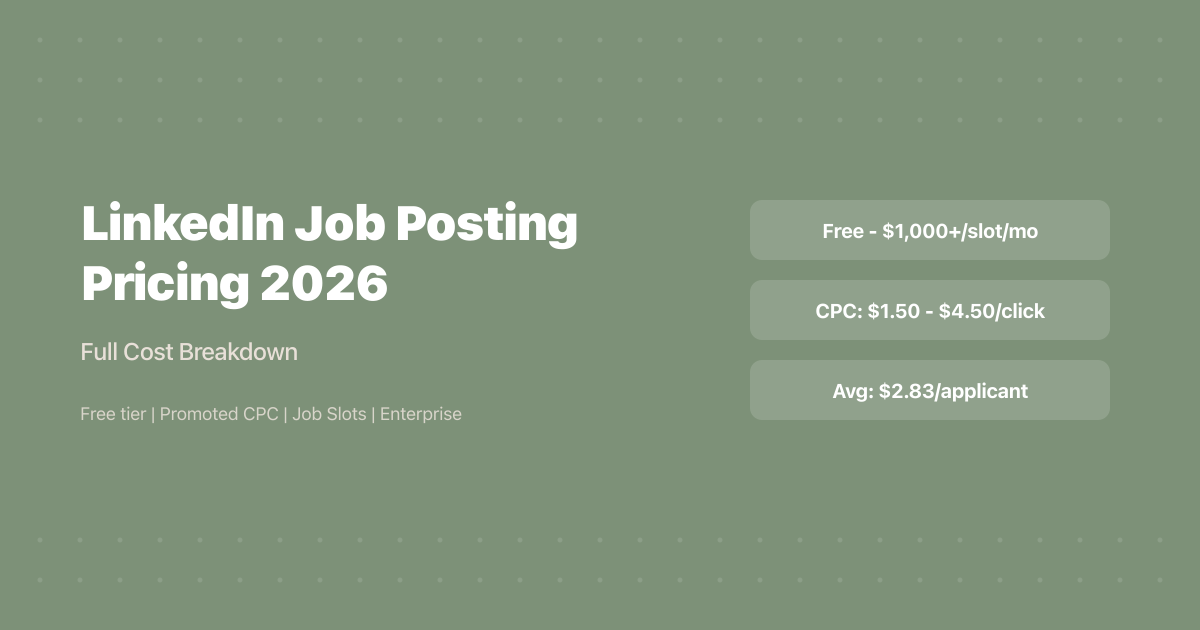
LinkedIn Recruiter pricing has climbed roughly 15% year over year without matching feature improvements, per HootRecruit's 2026 cost analysis. A Recruiter Lite seat costs $170/month ($2,040/year) and caps you at 30 InMails per month. Corporate seats run $750-$900/month ($8,999-$10,800/year) with 150 InMails. Professional Services seats for staffing firms land between $800-$1,080/month ($9,600-$12,960/year). Every additional InMail beyond your monthly cap costs $10.
Scale those numbers to a real team. Five Corporate seats cost $45,000-$54,000 per year in licensing alone. That doesn't include Talent Insights add-ons, job posting credits, or the InMail overages that pile up when your team runs out of messages mid-month. And LinkedIn doesn't allow seat sharing - every recruiter needs their own license, whether they use it 40 hours a week or 4.

| Platform | Annual Cost | InMails / Outreach | Multi-Channel |
|---|---|---|---|
| Pin Professional | $1,788/yr | Unlimited automated sequences | Email, LinkedIn, SMS |
| LinkedIn Recruiter Lite | $2,040/yr | 30 InMails/month | InMail only |
| LinkedIn Recruiter Corporate | $10,800/yr | 150 InMails/month | InMail only |
| LinkedIn Professional Services | $12,960/yr | 150 InMails/month | InMail only |
What are you actually getting for $10,800? A search engine limited to one network, capped InMail credits, and no outreach automation. Compare that to AI sourcing platforms that start at $100-$149/month, search across multiple data sources, and include automated multi-channel outreach. For a detailed tier-by-tier cost breakdown, see our LinkedIn Recruiter pricing guide for 2026.
The math doesn't lie. A single Corporate seat costs 6x more than a Pin Professional subscription ($10,800 versus $1,788 per year), while offering fewer features, fewer outreach channels, and lower response rates. For smaller agencies and growing teams, that gap is impossible to justify.
For staffing agencies, the cost problem is amplified. Agency recruiters need to search, outreach, and place across dozens of client accounts simultaneously. LinkedIn Recruiter charges per seat, doesn't share licenses across teams, and limits InMails on a per-user basis. A ten-person agency on Corporate seats could spend over $100,000 per year on LinkedIn alone - before any other tools in their stack. Platforms designed for agency workflows offer multi-client management from a single account at a fraction of that cost.
How Low Are LinkedIn InMail Response Rates?
The average InMail response rate across all campaigns is 6.38%, according to EngageKit's 2025 benchmark study of real recruiter outreach data. That's the campaign-level average - not the cherry-picked "top performer" number LinkedIn prefers to highlight. For software and SaaS recruiting, the picture is worse: response rates drop to 4.77% per SalesSo's 2026 analysis. Nearly two-thirds (63%) of LinkedIn members never respond to non-personalized InMails at all.
Why so low? InMail fatigue is real. Candidates in competitive fields receive dozens of InMails per month, and most are generic. LinkedIn's own data shows that messages under 400 characters get 22% higher response rates, according to SendIQ's 2025 report. But even optimized InMails can't overcome a fundamental problem: you're competing in one crowded channel against every other recruiter on the platform.
The industry breakdown makes it even clearer. InMail response rates for HR and talent acquisition roles average 12.08%. Legal and professional services hit 10.42%. But software and SaaS - where most tech recruiting happens - bottom out at 4.77%, per SalesSo (2026). If you're a tech recruiter paying $10,800/year for a channel where 95 out of 100 messages go unanswered, the value proposition collapses.
There's also the suspension risk that few recruiters realize exists until it hits them. If your InMail response rate drops below LinkedIn's internal threshold, the platform can suspend your bulk InMail sending privileges. You're still paying the full subscription fee. You just can't use the primary feature you're paying for. That's the kind of vendor lock-in that pushes teams toward alternatives where they own their outreach data and control their sending limits.

Multi-channel outreach - combining email, LinkedIn, and SMS in coordinated sequences - delivers up to 60% better results than InMail alone, according to research from EngageKit and Belkins (2025). Pin's automated multi-channel sequences hit a 48% response rate across email, LinkedIn, and SMS. That's not a top-quartile outlier - it's the platform average across all customers.
When you're paying $10,800 per year for a channel that converts at 6%, and a $1,788/year alternative converts at 48%, the ROI calculation becomes hard to ignore.
Does Single-Channel Lock-In Hurt Your Recruiting?
LinkedIn Recruiter confines all candidate communication to one channel: InMail. You can't send a candidate an email. You can't text them. You can't build a multi-touch sequence that follows up across different platforms. If a candidate doesn't check LinkedIn - or ignores InMails because their inbox is flooded - you've lost them entirely.
This matters more than most recruiters realize. Not every strong candidate lives on LinkedIn. Engineers often prefer GitHub, Stack Overflow, or personal websites. Healthcare professionals, manufacturing workers, and skilled tradespeople frequently have minimal LinkedIn profiles or none at all. A platform that only searches LinkedIn misses these people entirely.
The data backs this up. Multi-channel approaches that combine LinkedIn, email, and phone outreach yield 60% better response rates than single-channel InMail campaigns, per EngageKit's 2025 benchmarks. Modern AI sourcing platforms search across multiple data sources - not just LinkedIn - to build a complete picture of candidates. Pin's database includes 850M+ profiles with 100% coverage across North America and Europe, pulling from professional networks, public records, and verified contact databases simultaneously.
LinkedIn's 2024 restrictions made the single-channel problem worse. The company capped personalized connection requests on free accounts to 5-15 per month - down from unlimited, according to Full Stack Recruiter (2024). That move was designed to push more users toward paid InMail credits. But it also pushed recruiters to question whether doubling down on a platform that keeps tightening access is the right long-term strategy.
There's also the data lock-in problem. LinkedIn doesn't let you bulk export candidate contact information. Everything stays inside their ecosystem. If you decide to leave, you can't take your pipeline with you. That's not a feature - it's a retention strategy that benefits LinkedIn, not your recruiting team.
Why Can't You Automate Outreach on LinkedIn Recruiter?
LinkedIn explicitly prohibits automated outreach sequences on its platform. Every follow-up message requires a recruiter to manually log in, find the conversation, and type a response. There's no drip sequence. No automated follow-up on day 3 if a candidate hasn't replied. No scheduled sends. According to SHRM's 2025 Talent Trends report, 89% of organizations using AI for recruiting report time savings - yet LinkedIn Recruiter keeps its users stuck in manual workflows.
Think about what that means in practice. A recruiter managing 20 open positions sends maybe 50-100 InMails per day. Each one requires personalization. Each requires individual sending. And each follow-up requires manual tracking. That's hours of repetitive work every single day - hours that could go toward screening, interviewing, or closing candidates.
LinkedIn's prohibition on automation also creates a scaling ceiling. A recruiter using LinkedIn Recruiter can realistically manage outreach to maybe 50-80 candidates per day before hitting time and credit limits. An AI platform with automated sequences can manage hundreds of candidate touchpoints simultaneously - personalized, multi-channel, and tracked in real time. That's not a marginal improvement. It's a fundamentally different operating model.
AI-powered platforms handle this differently. They let recruiters set up multi-step outreach sequences that run automatically: initial message on day 1, email follow-up on day 3, LinkedIn touch on day 7, SMS on day 10. The recruiter defines the strategy once, and the platform executes it across channels. When a candidate responds, the conversation surfaces in a shared inbox where any team member can pick it up.
This is the operational gap driving the migration. Recruiters aren't leaving LinkedIn because they dislike the network. They're leaving LinkedIn Recruiter because the tool forces them to work like it's 2015 while the rest of their tech stack has moved on. Pin's outreach sequences automate the entire follow-up cadence across email, LinkedIn, and SMS - that's how it delivers a 48% response rate without requiring manual effort on every message. See how Pin's automated outreach works.
The AI Sourcing Wave Is Pulling Recruiters Away
AI adoption in HR jumped from 26% to 43% in a single year - a 17-point increase that represents the fastest adoption wave the recruiting industry has seen, according to SHRM's 2025 Talent Trends report. That same research found 51% of organizations now use AI specifically for recruiting tasks, and 32% automate candidate searches through AI sourcing tools.
The growth curve is even steeper when you look at employer-level adoption. A survey of 529 employers by iHire (2025) found that 25.9% of employers now use AI tools for hiring, up from 14.7% in 2024 and just 4.9% in 2023. That's a 428% increase in two years. These aren't just enterprise companies experimenting - small and mid-market teams are adopting AI sourcing as their primary candidate discovery method.
So what's actually driving the switch? In a word: results. SHRM's data shows 89% of organizations using AI for recruiting report time savings and efficiency gains, while 36% specifically cite cost reduction. Compare that to LinkedIn Recruiter's annual price hikes and stagnant feature set, and the calculus shifts fast.
LinkedIn has noticed. The company launched its Hiring Assistant (an AI agent for recruiters) in September 2025, according to LinkedIn's official announcement. Early adopter data claims it saves 4+ hours per role. But here's the catch: Hiring Assistant is bundled into enterprise-tier contracts, not available as a standalone product. Recruiter Lite users - the majority of LinkedIn's recruiting customer base - don't get access. That two-tier approach is pushing smaller teams toward independent AI platforms where advanced features aren't gated behind enterprise pricing.
What Are Recruiters Using Instead of LinkedIn Recruiter?
The recruiters leaving LinkedIn Recruiter aren't going back to job boards or cold calls. They're moving to AI-powered sourcing platforms that combine three capabilities LinkedIn Recruiter keeps separate: deep candidate search, automated multi-channel outreach, and interview scheduling.
The shift follows a predictable pattern. Recruiters start by supplementing LinkedIn with an AI sourcing tool. They run searches across larger databases, find candidates who don't surface in LinkedIn's results, and reach them through email and SMS instead of competing for attention in crowded InMail inboxes. Within a few months, the supplemental tool becomes the primary one, and the LinkedIn Recruiter license doesn't get renewed.
Pin fits this pattern. It searches 850M+ profiles - comparable to LinkedIn's network but pulling from multiple data sources rather than a single platform. Its AI-powered matching handles both niche specialist roles and high-volume hiring from the same interface. And its automated outreach sequences across email, LinkedIn, and SMS deliver a 48% response rate, according to Pin's verified first-party metrics.
John Compton, Fractional Head of Talent at Agile Search, put it directly: "I am impressed by Pin's effectiveness in sourcing candidates for challenging positions, outperforming LinkedIn, especially for niche roles." Nick Poloni, President at Cascadia Search Group, went further: "I jumped into Pin solo toward the end of 2025 and closed out the year with over $1M in billings during just the final 4 months - no team, no agency. The sourcing data is incredible, scanning 850M+ profiles with recruiter-level precision to uncover perfect-fit candidates I'd never find otherwise."
Laura Rust, Founder and Principal at Rust Search, described her own transition: "I switched to Pin because the product actually delivers. Pin helps me find needle-in-a-haystack candidates with real precision, like filtering by company size during someone's tenure, so I can zero in on the right operators for a specific stage."
The tools recruiters are switching to share a few common traits. They search multiple data sources simultaneously rather than being locked into one network. They automate outreach sequences across email, LinkedIn, and SMS rather than forcing manual sends. They provide verified contact information (email and phone) rather than trapping candidates behind a messaging paywall. And they cost between $100-$250/month rather than $750-$900/month per seat.
For a head-to-head breakdown of specific features, see our LinkedIn Recruiter vs Pin comparison. And for a broader list of options, our guide to LinkedIn Recruiter alternatives in 2026 covers 12 platforms across different price points and use cases.
LinkedIn's Response: Too Little, Too Late?
LinkedIn isn't standing still. The company has rolled out several features aimed at keeping recruiters on the platform. AI-Assisted Messages, launched in early 2025, use AI to personalize InMail text. LinkedIn claims these messages have a 44% higher acceptance rate and are accepted 11% faster than non-AI messages, according to LinkedIn's Wave 1 2025 product update.
That sounds impressive until you do the math. A 44% improvement on a 6.38% baseline gets you to about 9.2%. Better, sure. But still a fraction of what multi-channel AI platforms deliver. And AI-Assisted Messages only work within InMail - they don't solve the single-channel problem or the lack of automated sequences.
The Hiring Assistant, LinkedIn's AI agent launched globally in September 2025, shows more promise. Early data suggests it saves 4+ hours per role and reduces profile review volume by 62%. But its availability is limited to enterprise-tier contracts. LinkedIn hasn't published standalone pricing or made it available to Recruiter Lite subscribers. For the majority of recruiters - solo practitioners, small agencies, growing companies - these flagship AI features remain out of reach.
Meanwhile, LinkedIn's broader business signals suggest uncertainty. The company laid off approximately 1,400 employees between late 2023 and mid-2025, with the June 2025 round specifically cutting engineering and recruiting division roles, per Industry Leaders Magazine. LinkedIn Talent Solutions revenue is growing in only "low- to mid-single digits," according to Staffing Industry Analysts (2024-2025). Is this the company you want to double down on for your sourcing strategy?
How Do You Know It's Time to Leave LinkedIn Recruiter?
Not every recruiter should cancel their LinkedIn Recruiter subscription tomorrow. LinkedIn still has value for passive networking, employer branding, and direct connections with candidates you already know. The question is whether it deserves to be your primary sourcing and outreach tool - and for a growing number of teams, the answer is no.
Here are five signals that you've outgrown LinkedIn Recruiter:
- Your InMail response rate is below 10%. If you're sending messages that fewer than 1 in 10 candidates respond to, you're burning credits and time. Multi-channel outreach tools consistently outperform single-channel InMail campaigns.
- You're spending more than $5,000/year per recruiter on sourcing tools. LinkedIn Recruiter Corporate's $10,800/year price tag exceeds what most AI sourcing platforms charge for equivalent or better functionality. Run the math on your actual cost per hire through LinkedIn versus alternatives.
- You're hiring for roles where candidates aren't active on LinkedIn. Healthcare, skilled trades, cybersecurity, engineering - these fields have significant talent pools outside LinkedIn. A tool limited to one network limits your reach.
- Your team manually follows up on every outreach message. If your recruiters are spending hours per day on follow-up emails and InMail replies, automation would give them that time back. LinkedIn Recruiter doesn't offer it.
- You need email and phone contacts, not just InMail access. LinkedIn won't give you a candidate's email address or phone number directly. AI sourcing platforms include verified contact data as part of the package - Pin provides email and phone lookups through its contact credit system.
If three or more of these apply to your team, it's worth running a 30-day test with an alternative platform. Most offer free tiers or trials, so the switching cost is effectively zero.
How to Run a Side-by-Side Test
The smartest approach isn't canceling LinkedIn Recruiter overnight. It's running both tools in parallel for 30 days and comparing the results. Pick 5-10 open positions and source half through LinkedIn Recruiter, half through an AI alternative. Track three metrics: response rate, time to first qualified conversation, and cost per sourced candidate.
Most recruiters who run this test find the results speak for themselves. The AI platform delivers more responses, faster, at lower cost per candidate. At that point, the LinkedIn Recruiter renewal conversation becomes very different. Pin offers a free tier with no credit card required, so you can start the comparison without adding another line item to the budget. Start a free trial with Pin and compare your results side by side.
The Bottom Line
LinkedIn Recruiter built the recruiting industry's default sourcing tool. For years, it was the only game in town. That's no longer true. Rising costs, declining InMail effectiveness, single-channel limitations, and the absence of automation have created an opening that AI sourcing platforms are filling fast.
The numbers tell the story: $10,800/year for a Corporate seat that delivers 6% response rates, versus $1,788/year for a platform that delivers 48% response rates across three channels. AI adoption in recruiting has grown 428% since 2023, per iHire's 2025 survey. SHRM reports 89% of AI-adopting teams see time savings. The shift is structural, not cyclical.
LinkedIn won't disappear from recruiting. It remains a powerful professional network for branding, networking, and keeping up with industry contacts. But "powerful professional network" and "best sourcing tool" are no longer the same thing. Recruiters who recognize that distinction are the ones moving faster, filling roles in weeks instead of months, and keeping their sourcing budgets under control. Pin users fill positions in approximately 2 weeks on average - a timeline that reflects what's possible when sourcing, outreach, and scheduling all run from one automated platform.
For recruiters exploring sites like LinkedIn for recruiting, the market has never offered more capable or more affordable options. The question isn't whether alternatives exist - they clearly do. The real question is how long you keep paying premium prices for a tool that hasn't kept pace with the category it once defined.
Replace LinkedIn Recruiter with Pin - start free
Frequently Asked Questions
What is the average InMail response rate on LinkedIn Recruiter?
The average InMail response rate across all campaigns is 6.38%, according to EngageKit's 2025 benchmark study. Top-quartile campaigns reach 18-25%, but software and SaaS recruiting averages just 4.77% per SalesSo's 2026 data. Multi-channel outreach tools that combine email, LinkedIn, and SMS deliver significantly higher response rates - Pin reports 48% across its customer base.
How much does LinkedIn Recruiter cost per year?
LinkedIn Recruiter Lite costs $2,040/year ($170/month) with 30 InMails per month. Corporate seats run $8,999-$10,800/year ($750-$900/month) with 150 InMails. Professional Services for staffing firms costs $9,600-$12,960/year. Additional InMails cost $10 each. For a full breakdown, see our LinkedIn Recruiter pricing guide.
What are the best alternatives to LinkedIn Recruiter for sourcing?
AI sourcing platforms that search 850M+ profiles across multiple data sources are the primary alternative. Pin offers AI-powered candidate matching, automated multi-channel outreach (email, LinkedIn, SMS), and interview scheduling starting at $100/month with a free tier. For a full comparison of 12 options, see our guide to LinkedIn Recruiter alternatives in 2026.
Can I automate outreach on LinkedIn Recruiter?
No. LinkedIn explicitly prohibits automated outreach sequences on its platform. Every InMail and follow-up message must be sent manually. This is one of the primary reasons recruiters switch to AI sourcing tools - platforms like Pin automate multi-step outreach sequences across email, LinkedIn, and SMS while maintaining personalization through AI.
Is LinkedIn still worth using for recruiting?
LinkedIn remains valuable as a professional network for employer branding, passive networking, and direct connections. But as a primary sourcing and outreach tool, it's losing ground to AI alternatives that offer larger databases, multi-channel automation, and higher response rates at lower cost. According to SHRM's 2025 Talent Trends report, 43% of HR teams now use AI tools - up 17 points from the previous year.