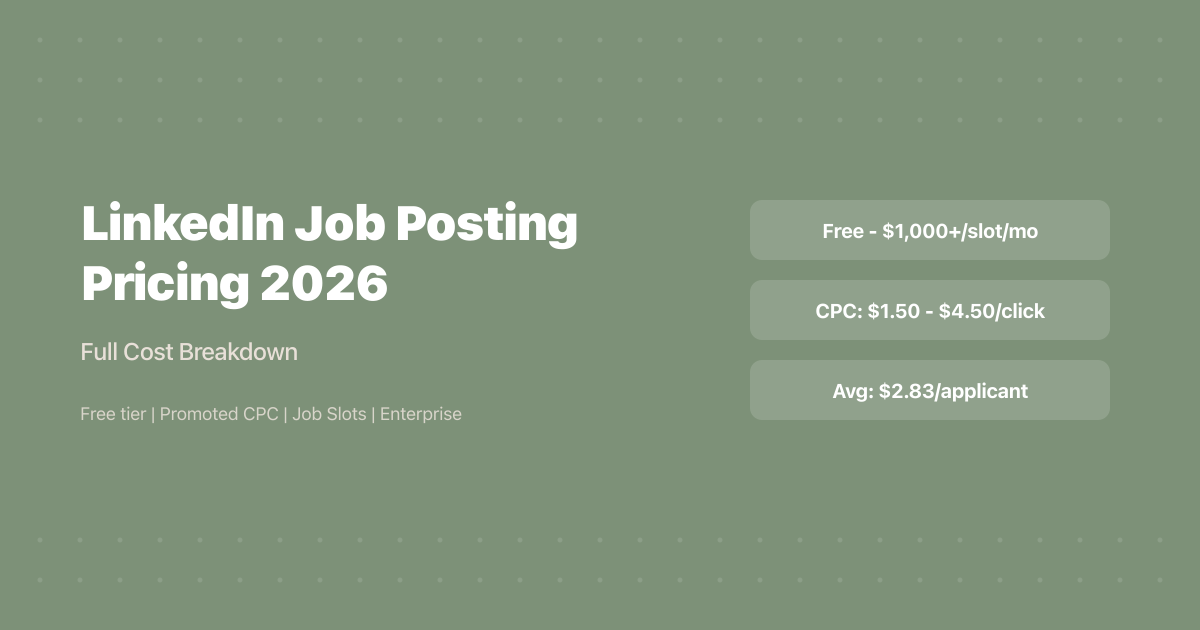
LinkedIn Recruiter pricing ranges from $1,680 per year for a single Recruiter Lite seat to $10,800-$15,000 per seat per year for Corporate plans, based on buyer-reported data through early 2026. LinkedIn doesn't publish pricing for its higher-tier plans, so you won't find a public rate card anywhere on their site.
Based on buyer-reported data compiled by HootRecruit and 100Hires (2026), a three-person Corporate team runs approximately $32,400 per year - and that's before InMail overages, job slots, and Talent Insights add-ons push the real spend higher. Multiple buyer reports indicate Corporate plan pricing has increased roughly 15% from prior-year rates, a pattern that shows no signs of slowing down.
This guide breaks down LinkedIn Recruiter's three plan tiers (Lite, Professional Services, and Corporate), maps out the hidden costs that inflate your bill beyond the subscription price, and compares the platform to five sourcing alternatives. Whether you're evaluating LinkedIn Recruiter for the first time or deciding whether to renew, you'll know exactly what to budget for.
TL;DR: LinkedIn Recruiter costs $1,680/yr (Lite) to $15,000+/seat (Corporate) with no public pricing on higher tiers. Hidden fees - InMail overages (~$10 each), Talent Insights ($6K-$20K/yr), ~15% annual price hikes - push total cost 20-40% above the subscription (HootRecruit, 2026). For sourcing-focused teams, AI recruiting platforms like Pin start at $100/mo with 850M+ profiles and automated outreach included.
What Does LinkedIn Recruiter Actually Cost in 2026?
LinkedIn Recruiter has three plan tiers, each targeting a different buyer. According to the LinkedIn official comparison page (2026), Recruiter Lite starts at $170/month ($1,680/year) for a single seat. Professional Services and Corporate pricing requires contacting LinkedIn's sales team directly.
Here's what companies are actually paying, based on buyer-reported data from HootRecruit, Litespace, and 100Hires (2025-2026):

A few things about LinkedIn's pricing model that buyers learn too late:
- No free tier. Every plan requires a paid subscription. There's no trial for Recruiter Corporate - you commit before testing it.
- Per-seat pricing. Each recruiter on your team needs their own license. Seat sharing isn't allowed. A 10-person team on Corporate pays $108,000/yr.
- Annual contracts on higher tiers. Lite offers month-to-month billing, but Professional Services and Corporate require annual commitments with auto-renewal.
- ~15% annual price increases. Corporate plans have increased approximately 15% year-over-year, according to HootRecruit (2026). That compounds fast over multi-year deals.
That last point is worth pausing on. A single Corporate seat at $10,800/yr becomes roughly $12,420 in year two and $14,283 by year three at 15% annual increases. Over three years, you'd pay $37,503 for one seat - nearly $5,000 more than if pricing held flat. For a three-person team, the compounding difference exceeds $14,000. If you're not negotiating a price cap into your contract, you're absorbing those increases automatically.
What Does Each LinkedIn Recruiter Plan Include?
LinkedIn Recruiter's three tiers differ dramatically in features, not just pricing. According to LinkedIn Help (2026), the core differences come down to network access, InMail volume, and collaboration tools. Here's the full breakdown:
| Feature | Recruiter Lite | Professional Services (RPS) | Corporate |
|---|---|---|---|
| Annual Cost (1 seat) | $1,680 | $6,000-$10,000 | $8,999-$15,000 |
| InMail Credits/Month | 30 | 100 | 150 (pooled) |
| Search Filters | 20+ | 40+ | 40+ |
| Network Access | Up to 3rd degree | Full 930M+ | Full 930M+ |
| Profile Views/Day | 2,000 cap | Expanded | Unlimited |
| AI-Assisted Search | - | Yes | Yes |
| AI-Assisted Messaging | - | Yes | Yes |
| Bulk Messaging | - | - | Yes (25 at once) |
| Team Collaboration | - | Limited | Full (shared projects) |
| ATS Integration | - | 28+ platforms | 28+ platforms |
| Advanced Analytics | Basic | Full suite | Full suite |
| Hiring Assistant (AI) | - | Add-on (RPS+) | Add-on |
Which Plan Should You Pick?
Recruiter Lite works for solo recruiters filling one to three roles per quarter who don't need team features or ATS integration. The 30 InMail credits per month run dry quickly at any meaningful outreach volume - if you're contacting 10 candidates per day, you'll burn through your monthly allotment in three days. But for occasional hiring managers or very small shops, Lite keeps costs low.
Professional Services (RPS) is designed for recruiting agencies and staffing firms. You get full network access to 930M+ LinkedIn members, 100 InMails per month, and AI-assisted search. If your team is 1-5 recruiters running active searches, RPS gives you significantly more reach than Lite at 3-6x the price.
Corporate targets mid-market and enterprise in-house teams. The 150 pooled InMails, unlimited profile views, bulk messaging, and full team collaboration make it the only viable option for teams running multiple searches simultaneously. But at $8,999-$15,000 per seat per year, it's also where the per-seat pricing model hits hardest. Is a 10-recruiter team getting $108,000/yr worth of value from LinkedIn alone? That question drives many teams to evaluate LinkedIn Recruiter alternatives at renewal time.
What Hidden Fees Does LinkedIn Recruiter Charge?
The subscription price is just the starting point. Based on buyer-reported cost analyses from multiple third-party sources (2026), the total cost of ownership for LinkedIn Recruiter runs 20-40% above the base subscription once add-ons and overages are factored in. Here are the costs that don't appear on the initial quote.
1. InMail Overages
When your monthly InMail allotment runs out, additional credits cost approximately $10 each (HootRecruit, 2026). That sounds manageable until you do the math. A Recruiter Lite user with 30 credits who needs to contact 100 candidates per month pays $700 extra in InMail overages alone - nearly half the annual subscription cost. Even Corporate users with 150 pooled credits can burn through their allotment in the first half of the month during peak hiring seasons.
The economics get worse when you factor in engagement. Average InMail response rates sit at just 10-25%, with the software and SaaS vertical hitting a dismal 4.77% (Sales So, Dec 2025). You're paying $10 per message for a channel where 75-95% of messages go unanswered.
2. LinkedIn Talent Insights
Want labor market analytics, talent pool sizing, or competitive intelligence? That's a separate product. LinkedIn Talent Insights runs $6,000-$20,000 per year depending on scope (Litespace, 2025). It's not bundled with any Recruiter plan. If your team needs data to build hiring strategies, this add-on can cost as much as the Recruiter subscription itself.
3. Promoted Job Posts
Posting a job on LinkedIn is free, but promoted listings - the ones that actually get visibility - start at $500+ per post (HootRecruit, 2026). Teams running 10+ active roles can spend thousands per month on job promotion alone. Job Slots, which give you priority placement, run $200-$1,000 per slot per month (Litespace, 2025).
4. Hiring Assistant Add-On
LinkedIn launched its AI-powered Hiring Assistant globally in September 2025, reporting a 62% reduction in profile reviews needed and 69% improvement in InMail acceptance rates (LinkedIn Newsroom, 2025). It handles proactive sourcing, candidate Q&A, and ATS sync. But it's an add-on to RPS+ and Corporate plans - not included in the base price. LinkedIn hasn't publicly disclosed the Hiring Assistant's pricing, which means another sales conversation and another line item.
5. Auto-Renewal and Cancellation Terms
LinkedIn contracts auto-renew by default. You must actively opt out before the renewal window or you're locked in for another year. Canceling forfeits access to all saved searches, projects, and message history. If you've built candidate pipelines inside LinkedIn Recruiter, walking away means losing that work entirely.
When you stack InMail overages, Talent Insights, promoted posts, and the Hiring Assistant add-on, a single Corporate seat budgeted at $10,800/yr realistically costs $14,000-$17,000 in actual annual spend. For a three-person team, that's $42,000-$51,000 per year all-in - and that's before the ~15% annual price increase hits. Does your renewal budget account for the real number?
By contrast, Pin's multi-channel outreach hits a 48% response rate across email, LinkedIn, and SMS - see how Pin compares to LinkedIn Recruiter.
How to Negotiate Your LinkedIn Recruiter Contract
Volume discounts of 5-25% are achievable on LinkedIn Recruiter contracts, depending on seat count and deal structure (Litespace, 2025). Multi-year commitments unlock an additional 5-15% (Spendflo, 2025). LinkedIn's quote-based model means every deal has room for negotiation. Four tactics that consistently reduce costs:
Time Your Negotiation
LinkedIn's fiscal year aligns with Microsoft's (ending June 30). The last two weeks of each fiscal quarter - March, June, September, and December - are when sales teams face the most pressure to close deals. If your evaluation timeline is flexible, push the final signature into a quarter-end window. Even a two-week delay can unlock discounts that weren't available earlier in the quarter.
Bring Competing Quotes
Request pricing from at least two alternatives before talking to LinkedIn's sales team. You don't need to prefer those platforms - having documented quotes gives you concrete numbers to cite. Documented cases show LinkedIn offering 5% discounts just to prevent a downgrade from Corporate to Lite (Spendflo, 2025). That's a modest discount on its own, but it signals willingness to negotiate.
Lock Volume Pricing Upfront
Seat-based discounts follow a clear pattern: 3-5 seats gets 5-10% off, and 10+ seats unlocks 10-25% off (Litespace, 2025). If you're buying 5+ seats, always negotiate the volume discount before signing. Don't assume it's applied automatically - the initial quote rarely includes it.
Cap Annual Increases
LinkedIn's ~15% annual increases are the default, not a rule. Ask for a contractual price cap - ideally 0-5% maximum annual increase - as part of your initial agreement. If you're signing a multi-year deal, include a Price Lock clause for year two. Without one, a $32,400/yr three-seat deal becomes roughly $37,260 in year two and $42,849 by year three. That's an extra $15,309 over three years for the same service.
LinkedIn Recruiter Lite vs Corporate: Is the Upgrade Worth It?
The gap between Lite ($1,680/yr) and Corporate ($10,800+/yr) is substantial - roughly a 6x price difference. But the feature gap is even wider. According to LinkedIn's comparison page (2026), Lite restricts you to 3rd-degree connections, 20 search filters, and 30 InMails per month with no team collaboration, no ATS integration, and no AI features.
Corporate gives you access to LinkedIn's full 930M+ member network, 150 pooled InMails, unlimited profile views, bulk messaging, shared projects, 28+ ATS integrations, and AI-powered search and messaging. LinkedIn reports that AI-assisted messaging on Corporate plans yields a 44% higher acceptance rate and responses arrive 11% faster (LinkedIn Product Update, 2025).
So is the upgrade worth it? That depends entirely on your hiring volume.
- Stick with Lite if you hire fewer than five people per year, source mostly from inbound applicants, and don't need team collaboration or ATS sync. The limited InMail credits won't bottleneck you at low volume.
- Upgrade to Corporate if you have multiple recruiters running active searches, need full network access beyond your connections, or require ATS integration. The per-seat cost is steep, but splitting it across enough hires brings the cost-per-hire down significantly.
- Consider alternatives entirely if your main need is proactive sourcing with multi-channel outreach. LinkedIn Recruiter restricts you to one channel (InMail). Dedicated sourcing tools cover email, LinkedIn, and SMS in a single workflow at a fraction of the per-seat cost.
For a full feature-by-feature breakdown, see our LinkedIn Recruiter vs Pin comparison.
How Does LinkedIn Recruiter Compare to 5 Sourcing Alternatives?
LinkedIn Recruiter sits at the premium end of sourcing tool pricing. The per-seat model means costs scale linearly with team size - every additional recruiter doubles, triples, or quadruples your bill. That's a fundamentally different model from platforms that charge flat subscription rates regardless of team size. Here's how the numbers compare:
| Platform | Starting Price | Free Tier | Database Size | Multi-Channel Outreach | Contract Minimum |
|---|---|---|---|---|---|
| Pin | $100/mo | Yes | 850M+ profiles | Email, LinkedIn, SMS | 3 months |
| LinkedIn Recruiter Lite | $170/mo | - | 930M+ (3rd degree only) | InMail only | Monthly |
| Manatal | $15/mo | - | Limited | Monthly | |
| SmartRecruiters | $100/mo | Limited | Limited | Annual | |
| LinkedIn Recruiter Corporate | $750-$900/mo per seat | - | 930M+ (full access) | InMail only | Annual |
| Entelo | ~$500/mo | - | Undisclosed | Email only | Annual |
The comparison reveals two structural disadvantages with LinkedIn Recruiter's pricing model. First, per-seat licensing means your sourcing costs scale linearly with team size. A five-person team on Corporate pays $54,000-$75,000 per year for LinkedIn alone. Second, LinkedIn restricts outreach to a single channel - InMail - where average response rates are 10-25% (Sales So, Dec 2025). Platforms with multi-channel outreach (email, LinkedIn, and SMS combined) consistently outperform single-channel approaches.
LinkedIn Recruiter's strengths are real: access to 930M+ member profiles, deep integration with the LinkedIn ecosystem, and AI-powered search features that keep improving. The platform scores 8.3 out of 10 on TrustRadius from 303 reviews (2025). Users praise the candidate database and search quality. The consistent complaints? Pricing, per-seat restrictions, and InMail limitations.
For teams exploring what else is available, see our full roundup of the best AI recruiting tools in 2026.
What If Sourcing Is Your Real Bottleneck?
LinkedIn Recruiter solves one problem well: searching LinkedIn's database. But modern recruiting requires more than searching one platform. Teams need to find candidates across multiple databases, reach them through multiple channels, and automate the follow-up that turns cold prospects into warm conversations. That's the gap between a search tool and a sourcing platform.
The cost difference is dramatic. A single LinkedIn Recruiter Corporate seat costs $10,800/yr and limits you to InMail outreach with a 10-25% response rate. Pin's AI sourcing scans 850M+ profiles, automates outreach across email, LinkedIn, and SMS, and delivers a 48% response rate - starting at $1,200/yr ($100/mo). Pin users fill positions in approximately two weeks.
As Rich Rosen, Executive Recruiter at Cornerstone Search, put it: "Absolutely money maker for recruiters... in 6 months I can directly attribute over $250K in revenue to Pin."
Here's how the sourcing investment compares side by side:
| Capability | LinkedIn Recruiter Corporate | Pin |
|---|---|---|
| Annual Cost (1 seat) | $10,800/yr | $1,200/yr ($100/mo) |
| Annual Cost (5 seats) | $54,000-$75,000/yr | $8,940/yr ($149/mo x 5, annual) |
| Candidate Database | 930M+ LinkedIn members | 850M+ profiles |
| Outreach Channels | InMail only | Email, LinkedIn, SMS |
| Published Response Rate | 10-25% (InMail avg) | 48% |
| Candidate Acceptance Rate | Not disclosed | ~70% |
| AI-Powered Search | Yes | Yes |
| Interview Scheduling | - | Yes (built-in) |
| Contact Info (Email/Phone) | Not included | Yes (credit-based) |
| Free Tier | - | Yes (no credit card) |
| SOC 2 Certified | Yes | Yes |
A five-person recruiting team running LinkedIn Recruiter Corporate pays $54,000-$75,000 per year for access to one database and one outreach channel. The same team on Pin's Professional plan pays $8,940 per year and gets access to 850M+ profiles, multi-channel outreach with a 48% response rate, and automated interview scheduling. That's roughly 83-88% less for comparable coverage and significantly higher engagement rates. Even adding Pin alongside a Lite subscription ($1,680 per seat) gives you broader reach at a fraction of Corporate pricing.
The takeaway isn't that LinkedIn Recruiter has no value. Its candidate database is massive, and its integration with the LinkedIn ecosystem is something no competitor can replicate. But if your primary bottleneck is sourcing - finding and engaging the right candidates before your competition does - the per-seat model makes LinkedIn Recruiter one of the most expensive ways to solve that problem. Many teams are shifting to a hybrid approach: keeping a LinkedIn Recruiter Lite subscription for passive browsing while using a dedicated AI sourcing platform for active outreach.
Frequently Asked Questions
How much does LinkedIn Recruiter cost per year?
LinkedIn Recruiter Lite costs $1,680 per year for a single seat, based on the LinkedIn official comparison page (2026). Professional Services (RPS) runs $6,000-$10,000 per seat per year, and Corporate plans cost $8,999-$15,000 per seat per year. A three-person Corporate team pays approximately $32,400/yr. LinkedIn doesn't publish pricing for higher-tier plans.
What are LinkedIn Recruiter's hidden costs?
The biggest hidden costs include InMail overages (~$10 per credit beyond your monthly allotment), LinkedIn Talent Insights ($6,000-$20,000/yr), promoted job posts ($500+ each), Job Slots ($200-$1,000/slot/month), and ~15% annual price increases on Corporate plans (HootRecruit, 2026). Total cost of ownership runs 20-40% above the subscription price.
Is LinkedIn Recruiter Lite worth it?
Recruiter Lite works for solo recruiters filling fewer than five positions per year. At $170/month, you get 30 InMails, 20+ search filters, and access up to 3rd-degree connections. But it lacks ATS integration, team collaboration, AI features, and full network access. Most active recruiters outgrow Lite within a few months due to InMail limits and restricted search capabilities.
What is the average InMail response rate?
Average InMail response rates range from 10% to 25%, with top-performing recruiters reaching 18-25% (Sales So, Dec 2025). The software and SaaS vertical has the lowest rate at just 4.77%. By comparison, multi-channel outreach platforms that combine email, LinkedIn, and SMS consistently report higher engagement - Pin users see a 48% response rate across channels.
What are the best LinkedIn Recruiter alternatives for sourcing?
AI sourcing platforms offer similar or larger candidate databases at a fraction of LinkedIn Recruiter's per-seat pricing. Pin accesses 850M+ profiles with automated multi-channel outreach starting at $100/mo. For a full comparison of options, see our guide to AI recruiting tools and how they work.
Should You Buy LinkedIn Recruiter in 2026?
LinkedIn Recruiter is the most recognized sourcing tool in recruiting. Its 930M+ member database is unmatched in depth, and the AI-powered search features keep improving. For in-house teams with the budget, Corporate delivers genuine value through full network access, team collaboration, and ATS integration.
But the per-seat pricing model creates a math problem that gets harder to justify as teams grow. A five-person Corporate team at $54,000-$75,000 per year is paying a premium for access to a single database and a single outreach channel. Add InMail overages, Talent Insights, and promoted posts, and the real number climbs higher.
Before renewing or signing a new LinkedIn Recruiter contract, run this simple calculation: What is your cost per hire through LinkedIn alone? Compare that to what you'd spend on a dedicated AI sourcing platform that covers sourcing, multi-channel outreach, and scheduling in one workflow. A Lite seat at $1,680/yr alongside Pin at $1,200/yr covers both passive browsing and active multi-channel outreach for $2,880 total - less than a third of one Corporate seat. For many teams, that hybrid model delivers better results at dramatically lower cost.
Replace LinkedIn Recruiter with Pin - start sourcing free today →