Updated At: Mar 18, 2026
An AI hiring assistant is software that uses artificial intelligence to handle recruiting tasks that normally eat up a recruiter's entire day - sourcing candidates, writing outreach, screening resumes, and scheduling interviews. Think of it as an AI recruiting assistant - a digital teammate that handles top-of-funnel recruiting while you focus on interviewing and closing candidates.
This isn't a niche tool anymore. Fifty-one percent of organizations now use AI specifically for recruiting, interviewing, or hiring, according to SHRM's 2025 Talent Trends report. And among those who've adopted it, 89% say it saves time or makes them more efficient. That's not a soft endorsement - it's near-universal agreement that the technology works.
But "AI hiring assistant" has become a loose term. Some vendors slap it on a chatbot that answers FAQs. Others use it for full-stack platforms that handle sourcing through scheduling. This guide cuts through the noise. You'll learn what an AI recruiting assistant actually does, the technology behind it, which features matter most, and how to tell whether a tool delivers real results or just marketing copy.
TL;DR: An AI hiring assistant automates sourcing, outreach, screening, and scheduling using machine learning and NLP. SHRM reports 89% of HR teams using AI see time savings. The best platforms scan hundreds of millions of profiles, personalize multi-channel outreach, and schedule interviews without manual effort. Look for database size, outreach automation, and measurable response rates when evaluating tools.
What Does an AI Hiring Assistant Actually Do?
An AI hiring assistant handles four core recruiting tasks in one connected workflow: sourcing candidates, sending personalized outreach, screening applicants, and scheduling interviews. Sixty-six percent of HR professionals already use AI for job descriptions, 44% for resume screening, and 32% for candidate searches, according to SHRM's 2025 Talent Trends report. What separates an AI hiring assistant from those individual tools is integration - it connects all of these tasks into a single pipeline instead of treating each one as a separate point solution.

Here's the day-to-day breakdown. A full-stack recruiting AI handles four broad categories of work:
Candidate Sourcing
The assistant searches large candidate databases - sometimes hundreds of millions of profiles - using natural language understanding instead of rigid Boolean strings. You describe the ideal candidate in plain language, and the AI interprets meaning, not just keywords. A search for "backend engineers with payments experience" won't miss someone whose profile says "built transaction processing systems." For a deeper look at how AI sourcing works under the hood, see the full guide to AI candidate sourcing.
Outreach and Engagement
Once candidates are identified, the assistant drafts personalized messages and sends them across email, LinkedIn, and SMS. It doesn't send the same template to everyone. Good AI outreach tools reference specific details from a candidate's profile - their current company, recent projects, relevant skills - so messages feel individually crafted. That personalization drives measurable results. Pin's automated outreach delivers a 48% response rate across channels.
Screening and Ranking
Instead of a recruiter reviewing 250 resumes manually, the AI evaluates every applicant against the job requirements and produces a ranked shortlist. It weighs factors like skills match, experience depth, career trajectory, and company-size fit. The recruiter still makes the final call, but the initial filtering happens in seconds instead of hours.
What makes this different from a basic ATS keyword filter? Semantic understanding. A traditional filter rejects a candidate whose resume says "people management" when the job description asks for "team leadership." AI screening understands those phrases mean the same thing and scores the candidate appropriately.
Interview Scheduling
The assistant handles the back-and-forth that eats up recruiter time: checking calendars, proposing time slots, sending confirmations, handling reschedules. No more email ping-pong. Some tools connect directly to Google Calendar or Outlook and book meetings without any recruiter involvement. For a deeper look at the scheduling piece, see the guide to AI interview scheduling.
Why does this matter? Because scheduling delays kill candidate interest. A three-day email exchange to find a time slot gives candidates room to accept competing offers or simply lose enthusiasm. Automated scheduling collapses that gap to minutes.
What makes this different from separate point solutions? Integration. An automated recruiting platform runs all four of these functions in one connected workflow. When a sourced candidate responds to outreach, the system automatically moves them to screening. When they pass screening, it triggers scheduling. No manual handoffs, no candidates falling through the cracks between tools.
How Does the Technology Behind AI Hiring Assistants Work?
AI recruiting platforms combine three technologies: natural language processing (NLP) to read resumes and profiles, machine learning (ML) to improve recommendations over time, and large language models (LLMs) to generate personalized outreach. Recruiters who use generative AI save roughly 20% of their workweek - about one full day - according to LinkedIn's Future of Recruiting 2025 report. Here's what each layer does and why the combination matters.
Natural Language Processing (NLP)
NLP is what allows the system to read and understand unstructured text - resumes, job descriptions, LinkedIn profiles, even email replies. It identifies entities (job titles, skills, company names, certifications) and extracts meaning from context. When a candidate writes "led a team of 12 engineers," NLP understands that's leadership experience, not just a sentence containing the word "team."
Modern NLP goes beyond keyword extraction. Semantic models understand that "people management" and "team leadership" and "direct reports" all point to the same capability. This is why AI-powered searches surface candidates that Boolean strings miss entirely.
Machine Learning (ML)
ML is the engine that improves over time. Every time a recruiter accepts or rejects a candidate recommendation, the model adjusts its understanding of what "good fit" means for that team, role, or industry. Early recommendations are solid. After a few months of feedback data, they're significantly more accurate.
The feedback loop matters more than most buyers realize. A tool that doesn't learn from your decisions is running a static algorithm - it'll give you the same results in month six that it gave you in month one. True ML-powered assistants get smarter with use.
Large Language Models (LLMs)
The latest generation of AI tools for talent acquisition uses large language models for tasks that require generating human-quality text. Writing personalized outreach messages. Summarizing candidate profiles. Drafting job descriptions. Even answering candidate questions via chat. LLMs are what make AI outreach feel personal rather than templated - they can reference a candidate's specific background and explain why a role is relevant to their career trajectory.
Here's the practical distinction most vendors won't explain clearly: NLP reads and understands text, ML learns and improves from data, and LLMs generate new text. A recruiting platform that only uses NLP can search well but can't write. One that only uses LLMs can write but can't learn from your feedback. The strongest tools combine all three - search that understands meaning, recommendations that improve over time, and communication that reads like a real recruiter wrote it.
Artificial Intelligence: The Robots Are Now Hiring
What Are the Core Features to Look For?
The five features that matter most are database size, multi-channel outreach, intelligent matching, automated scheduling, and pipeline analytics. Eighty-eight percent of HR leaders say their organizations haven't realized significant business value from AI tools yet, according to a Gartner survey published in October 2025. That gap between adoption and impact usually comes down to choosing tools with flashy demos but weak fundamentals. Here's what each feature should look like.
1. Large, Verified Candidate Database
The AI is only as good as the data it searches. A tool with 10 million profiles will miss candidates that a tool with 850 million profiles finds easily. Database size isn't vanity - it directly determines whether you can fill niche roles and hard-to-source positions. Look for platforms that disclose their database size and geographic coverage. Pin, for example, covers 850M+ profiles with 100% coverage in North America and Europe.
2. Multi-Channel Automated Outreach
Email alone isn't enough. Candidates respond on different channels depending on their seniority, industry, and how active they are in their job search. An automated recruiting tool should handle email, LinkedIn, and SMS from one interface, with sequencing (follow-ups if the first message goes unanswered) and personalization built in.
The response rate tells you whether outreach is working. Industry averages for cold recruiting emails sit in the low single digits. Pin's AI-powered outreach achieves a 48% response rate - that gap is the difference between a tool that generates activity and one that generates actual conversations.
3. Intelligent Screening and Matching
Surface-level keyword matching isn't enough. The tool should use semantic understanding to evaluate candidates based on skills, experience context, and career trajectory - not just whether the right buzzwords appear on their profile. Ask vendors how their matching works. If they can't explain it beyond "AI magic," that's a red flag.
Pin's matching accuracy is reflected in its numbers: approximately 70% of candidates that Pin recommends are accepted into customers' hiring pipelines. That acceptance rate is the clearest signal that the matching algorithm understands what recruiters actually want, not just what the job description says on paper.
4. Automated Interview Scheduling
Scheduling is where many recruiting workflows break down. A candidate is interested, but then three days of email back-and-forth kills their momentum. Good recruiting automation tools sync with your calendar, propose available slots, handle confirmations, and manage reschedules - all without the recruiter touching anything.
5. Analytics and Pipeline Reporting
Only 20% of organizations currently track quality of hire, according to SHRM's 2025 Recruiting Benchmarking report. That's a problem. If you can't measure whether your recruiting AI is improving outcomes, you're flying blind. Look for tools that report on response rates, time-to-fill, candidate acceptance rates, and source-of-hire data.
For a broader comparison of which platforms deliver on these features, see the best AI recruiting tools breakdown.
What Benefits Does the Data Actually Show?
The data shows three measurable benefits: faster time-to-fill, lower cost-per-hire, and improved quality of hire. Eighty-nine percent of HR professionals using AI report time savings or efficiency gains, according to SHRM's 2025 Talent Trends report. But "time savings" is a broad claim. Here's what happens when you break it down by specific outcome.
Faster Hiring Cycles
The average time-to-fill sits at approximately six weeks, per SHRM's 2025 benchmarking data. These tools attack every bottleneck in that timeline simultaneously. Sourcing that took days happens in minutes. Outreach that took a week launches in hours. Scheduling that consumed 10+ emails resolves automatically.
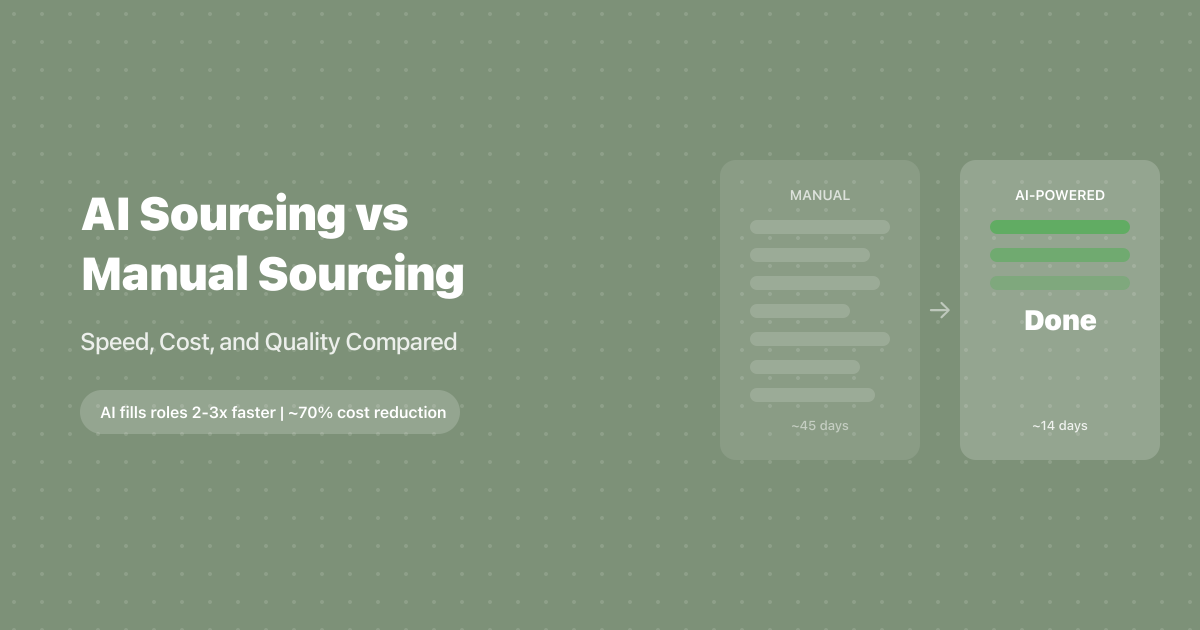
Recruiters using Pin fill positions in approximately two weeks - roughly a third of the industry average. That speed advantage comes from having sourcing, outreach, and scheduling working as one connected system rather than separate manual steps.
Lower Cost-Per-Hire
Thirty-six percent of organizations report that AI reduces their recruitment costs, according to SHRM's 2025 Talent Trends report. The math is straightforward: when one recruiter can manage the pipeline work that used to require two or three, your cost-per-hire drops. Factor in reduced agency fees, lower job board spend, and fewer lost candidates from slow processes, and the savings compound.
Pricing matters here too. Enterprise AI recruiting platforms often start at $10,000-$35,000+ per year. Pin starts at $100/month with a free tier that requires no credit card - a fraction of what legacy tools charge for comparable functionality.
Better Quality of Hire
Sixty-one percent of TA professionals believe AI can improve quality of hire measurement, and companies using AI-assisted messaging are 9% more likely to make a quality hire, according to LinkedIn's Future of Recruiting 2025 data. Quality improvement comes from two places: better candidate identification (the AI finds people that manual searches miss) and better engagement (personalized outreach attracts higher-caliber candidates who wouldn't respond to generic templates).
As one recruiting agency leader put it about his experience with Pin's recruiting AI: "I jumped into Pin solo toward the end of 2025 and closed out the year with over $1M in billings during just the final 4 months - no team, no agency," said Nick Poloni, President at Cascadia Search Group. "The sourcing data is incredible, scanning 850M+ profiles with recruiter-level precision to uncover perfect-fit candidates I'd never find otherwise."

Pin's multi-channel outreach hits a 48% response rate across email, LinkedIn, and SMS - try it free.
What Are the Risks and Limitations?
The three biggest risks are bias in AI decision-making, candidate pushback against automated screening, and the gap between buying a tool and actually implementing it well. Only 18% of college students view AI screening favorably, down from 22% in 2023, and 53% actively disagree with its use in hiring, according to a NACE Journal survey published in 2025. That growing skepticism makes thoughtful implementation more important than ever.
Bias Risk Is Real but Manageable
AI systems learn from historical data, and historical hiring data contains bias. The EEOC's $365,000 settlement with iTutorGroup - over an AI system that auto-rejected female applicants over 55 and male applicants over 60 - was a wake-up call for the industry. NYC's Local Law 144 now requires annual bias audits for any automated employment decision tool, with public reporting of results.
The fix isn't avoiding AI entirely. It's choosing tools with built-in guardrails. Look for platforms that remove names, gender, photos, and other protected characteristics before the AI evaluates candidates. Pin's approach strips all demographic identifiers from the AI pipeline and runs regular third-party fairness audits - the same standard required by the strictest current regulations.
Candidate Experience Requires Attention
Ninety-three percent of hiring managers say human involvement in hiring remains critical even when using AI, per an Insight Global survey of 1,005 U.S. hiring managers. They're right. Candidates notice when outreach feels robotic, when scheduling is impersonal, or when rejections come without context. The best automated recruiting tools handle the logistics while keeping the human touch where it matters most - conversations, interviews, and decisions.
Implementation Gap
Only 17% of HR professionals describe their AI implementation as "highly successful," according to SHRM's 2025 research. That's not a technology failure - it's an implementation failure. Organizations that invest in training, set clear expectations, and start with specific use cases (like sourcing for a particular role type) see far better results than those that buy a tool and expect it to work out of the box. SHRM found that teams using AI change management best practices are 2.6x more likely to report successful outcomes.
How Should You Evaluate an AI Hiring Assistant?
Evaluate on five dimensions: database size, outreach response rates, matching quality, compliance certifications, and total cost of ownership. Seventy-three percent of talent acquisition professionals agree that AI will change how their organizations hire, according to LinkedIn's Future of Recruiting 2025 report. But agreeing AI matters and picking the right tool are two different things. Here's what to actually check during your evaluation.
Ask About Database Size and Freshness
How many profiles does the tool search? How often is the data updated? A massive database with stale data produces outdated results. A small database with fresh data misses too many candidates. You want both. Ask for specific numbers, not vague claims like "millions of profiles."
Request Response Rate Data
Any tool can send messages. The question is whether candidates actually reply. Ask vendors for their aggregate response rates. If they can't or won't share them, that's a signal. Industry-average cold email response rates for recruiting sit in the low single digits. Anything above 20% is strong. Above 40% is exceptional.
Test the Matching Quality
Run a real search during the trial. Pick a role you've recently filled and see if the tool surfaces candidates comparable to (or better than) who you actually hired. If the top-10 results are irrelevant, the AI isn't sophisticated enough for your needs. Pin achieves a ~70% candidate acceptance rate - meaning seven out of ten recommended candidates make it into the hiring pipeline.
Check Compliance Certifications
At minimum, look for SOC 2 Type 2 certification. That verifies the platform meets enterprise-grade standards for data encryption, access controls, and security protocols. Ask about bias audit processes, especially if you hire in jurisdictions with AI hiring regulations (New York City, Illinois, Colorado). Pin holds SOC 2 Type 2 certification and publishes compliance documentation through its trust center.
Compare Total Cost of Ownership
Enterprise AI recruiting tools often require five-figure annual contracts, lengthy implementation cycles, and dedicated admins. Some add per-seat or per-hire charges that inflate costs as you scale. Compare total annual spend, not just the per-month list price. A tool that costs $100/month with self-serve onboarding may deliver more value than one that costs $25,000/year but takes three months to implement.
For a deeper look at the broader category, see the full guide to AI recruiting and how it's changing the industry.
Workplace Trends 2026: AI Recruitment, Boomerang Hiring, More
How Do AI Hiring Assistants Compare to Other Recruiting Tools?
An AI recruiting platform covers the full top-of-funnel workflow; an ATS, CRM, or sourcing-only tool covers one stage. According to SHRM's 2025 data, 43% of organizations use AI in HR, up from 26% in 2024. That rapid adoption means recruiters are evaluating multiple tool categories simultaneously. Here's how they stack up.
| Tool Type | What It Does | What It Doesn't Do |
|---|---|---|
| AI Hiring Assistant | Sourcing + outreach + screening + scheduling in one workflow | Doesn't replace your ATS or handle offer management |
| ATS (Applicant Tracking System) | Tracks applicants through stages, manages compliance | Doesn't source proactively or send outreach |
| Recruiting CRM | Manages candidate relationships and talent pools | Limited AI sourcing, often no automated scheduling |
| Sourcing-Only Tool | Finds candidates via search | No outreach, no screening, no scheduling |
| Chatbot/Screening Bot | Qualifies candidates via chat | Doesn't source or handle outreach to passive candidates |
The key distinction: most recruiting tools handle one stage of the hiring funnel. An AI hiring assistant handles the top of funnel end to end. That's why many teams use a recruiting assistant alongside their existing ATS - it finds and engages candidates while the ATS manages them through interview and offer stages. They're complementary, not competing. To see how automation connects across these stages, see the guide to automating your recruiting workflow.
What Does the Future Look Like?
The next wave of AI recruiting assistants is already taking shape. The shift is from "AI that assists" to "AI that acts" - platforms that don't just recommend candidates but take autonomous actions across the recruiting workflow. Gartner's 2025 Hype Cycle for Talent Acquisition places agentic AI (autonomous AI agents that complete multi-step tasks independently) as an emerging innovation trigger, per their October 2025 press release.
What does that look like in practice? An AI recruiting agent that finds candidates, writes personalized outreach, handles replies, screens responses, schedules interviews, and sends prep materials to the hiring manager - all while the recruiter focuses on closing candidates and building relationships. Some platforms are already moving in this direction. For an in-depth look, see the guide to AI recruiting agents.
The World Economic Forum projects 170 million new jobs created globally by 2030, with 70% of organizations planning to hire people with AI-related skills, per their 2025 Future of Jobs Report. That hiring volume means the demand for AI-powered recruiting tools will only increase. Teams that adopt effective AI recruiting software now won't just hire faster today - they'll have trained, calibrated systems ready to handle the hiring surge ahead.
Frequently Asked Questions
What is the best AI hiring assistant for recruiters?
The best AI hiring assistant combines a large candidate database, multi-channel outreach, automated scheduling, and measurable results. Pin scans 850M+ profiles, delivers a 48% outreach response rate, and starts at $100/month with a free tier. Look for tools that disclose their database size and share aggregate performance data rather than relying on marketing claims.
Can an AI hiring assistant replace a recruiter?
No. An AI recruiting assistant handles repetitive top-of-funnel work - sourcing, outreach, scheduling - so recruiters can focus on interviewing and closing candidates. Ninety-three percent of hiring managers say human involvement remains critical even with AI, per Insight Global's 2025 survey. The technology works best as a force multiplier, not a replacement.
How much does an AI hiring assistant cost?
Pricing ranges from free tiers (like Pin's no-credit-card-required plan) to $10,000-$35,000+ per year for enterprise platforms. Pin's paid plans start at $100/month. Most enterprise tools require annual contracts and lengthy onboarding. Compare total cost including implementation time, not just list price, when evaluating options.
Is AI hiring biased?
AI systems can inherit bias from historical hiring data if not designed carefully. The EEOC's $365,000 settlement with iTutorGroup highlighted the risk of unchecked AI screening. Modern platforms address this by removing protected characteristics before AI evaluation and conducting regular bias audits. NYC's Local Law 144 now requires annual audits for automated hiring tools. Choose vendors that publish compliance certifications and explain their bias prevention approach.
How long does it take to implement an AI hiring assistant?
Implementation time varies widely. Self-serve platforms like Pin can be set up the same day, with searches running within minutes. Enterprise platforms often require weeks to months for integration, training, and configuration. SHRM found that only 17% of AI implementations are rated "highly successful," with the biggest differentiator being proper training and change management during rollout.