Updated At: Mar 27, 2026
What is AI recruiting? AI recruiting is the use of artificial intelligence to automate core hiring tasks - sourcing candidates, screening resumes, managing outreach, and scheduling interviews. An AI recruiter handles the repetitive work that used to consume entire days: searching databases, crafting personalized messages, and coordinating calendars. Instead of spending hours on manual searches and repetitive emails, hiring teams use AI recruitment software to run those tasks at scale while they focus on relationships and final decisions.
Adoption is accelerating fast. Forty-three percent of companies now use AI for HR tasks, up from 26% just one year earlier, according to SHRM's 2025 Talent Trends report surveying 2,040 HR professionals. That momentum isn't slowing: the World Economic Forum's Future of Jobs Report 2025 found 86% of employers expect AI to transform their business by 2030, and 70% are already hiring specifically for AI-related skills - a strong signal that AI in recruiting isn't a pilot project anymore, it's a permanent infrastructure shift.
This guide breaks down exactly how AI recruiting works, the measurable benefits it delivers, what to look for when choosing a platform, and how to implement it without disrupting your current workflow.
TL;DR: What is AI recruiting? It's the use of artificial intelligence to automate sourcing, screening, outreach, and scheduling. SHRM reports 43% of companies now use AI for HR - up 17 points in one year. AI recruitment software like Pin acts as an AI recruiter that scans 850M+ profiles and delivers 48% outreach response rates. This guide explains how AI in recruiting works and how to get started.
How Does AI Recruiting Differ from Traditional Hiring?
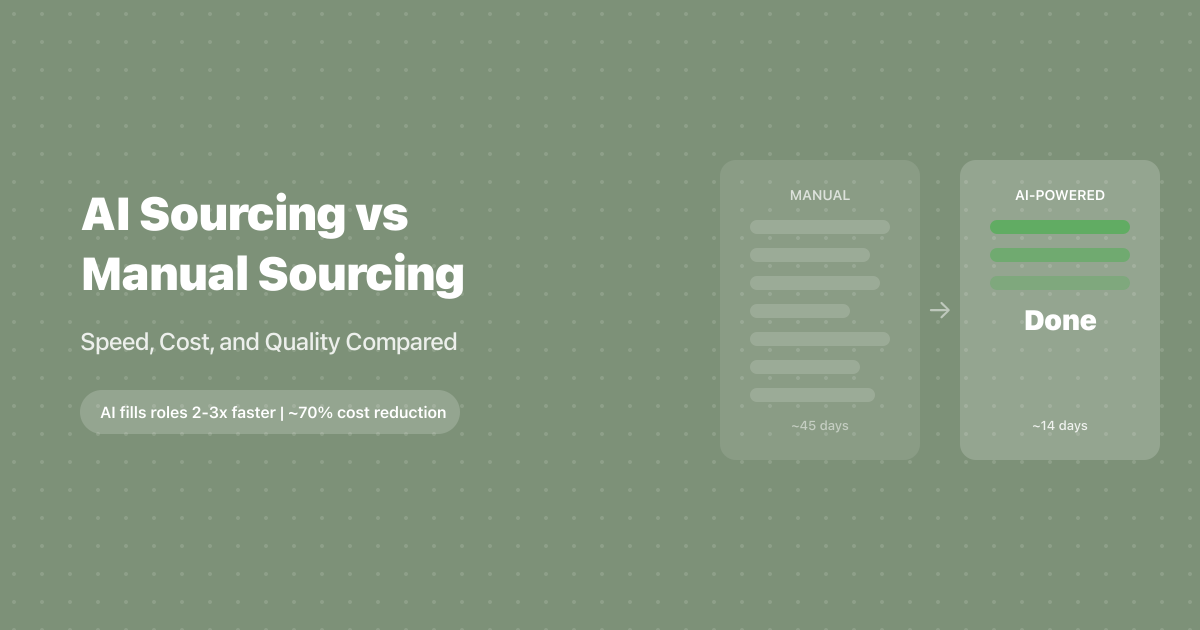
AI-enabled recruiting technology delivers 2-3x faster time-to-hire compared to manual methods, according to the Josh Bersin Company's 2025 research on talent acquisition. That speed gap captures the fundamental shift between traditional and AI-powered hiring.
Traditional recruiting is labor-intensive at every stage. A recruiter manually searches LinkedIn or job boards, reviews profiles one at a time, crafts individual outreach messages, and plays phone tag to coordinate interview schedules. Each step creates bottlenecks. And when you're filling multiple roles at the same time? The whole process slows to a crawl.
The numbers confirm the pain. Only 17% of applicants reached the interview stage in 2024, and 60% abandoned applications due to slow processes, according to the Josh Bersin Company's research. That's not a sourcing problem - it's a speed problem. Traditional workflows simply can't keep up with candidate expectations.
AI recruiting flips that model. Think of an AI recruiting assistant as a tireless team member that handles sourcing, outreach, and scheduling around the clock - while your human recruiters focus on relationship-building and closing. Here's how the two approaches compare:
| Task | Traditional Recruiting | AI Recruiting |
|---|---|---|
| Sourcing | Search hundreds of profiles manually | Scan millions of profiles in seconds |
| Shortlisting | Days or weeks to build a list | Qualified candidates in minutes |
| Screening | Review resumes one at a time | Rank all candidates by fit instantly |
| Outreach | 200 emails = one full week | 200 personalized messages in hours |
| Scheduling | Back-and-forth emails and phone tag | Automated calendar coordination |
| Consistency | Quality drops with fatigue | Same criteria applied every time |
The data tells the story clearly - AI adoption in HR nearly doubled in a single year.

That 17-point jump represents one of the fastest adoption curves in HR technology. And it's not limited to enterprise teams - recruiting agencies and mid-market companies are adopting AI recruitment tools at similar rates. Whether you call it artificial intelligence recruiting, AI hiring software, or simply AI in recruiting, the underlying trend is the same: machines handle the repetitive volume work so human recruiters can focus on judgment calls.
How Does AI Recruiting Work?
AI recruiting works through four connected functions: sourcing, screening, outreach, and scheduling. Each step feeds into the next, creating an end-to-end AI recruiting automation workflow that replaces what used to take a team of recruiters weeks. Thirty-seven percent of talent acquisition professionals are already integrating generative AI into these workflows, according to LinkedIn's 2025 Future of Recruiting report. Here's what each function does.
1. AI Candidate Sourcing
AI sourcing goes far beyond keyword matching. Instead of searching for exact title matches, AI understands context and intent. Ask for "series-B fintech CFO with APAC experience" and the AI interprets what that actually means - evaluating company stage, industry focus, seniority signals, and geographic history across millions of profiles at the same time.
Platforms like Pin scan 850M+ candidate profiles with 100% coverage in North America and Europe. That kind of database coverage means AI sourcing finds candidates that don't appear in a typical LinkedIn Recruiter search - people who haven't updated their profiles recently, or who are active on other professional networks. For a deeper look at this capability, see our guide to AI candidate sourcing.
2. Automated Screening
Once candidates are sourced, AI evaluates and ranks them by fit against your specific requirements. It isn't just checking boxes - it's weighing experience relevance, career trajectory, and skill depth. According to SHRM, 44% of HR teams already use AI for screening resumes, making it the second most common AI use case in recruiting.
What makes AI screening different from an ATS keyword filter? Context. An ATS rejects a resume missing the exact phrase "project management." AI understands that "led cross-functional team of 12" and "managed $2M product launch" signal the same capability. That contextual reading means fewer false negatives and a stronger shortlist.
3. Multi-Channel Outreach
AI sends personalized messages across email, LinkedIn, and SMS - adjusting timing, messaging, and channel based on what's most likely to get a response. This isn't mail merge with a name field swapped in. Modern AI outreach reads candidate profiles and crafts genuinely relevant messages that reference specific experience, projects, and career signals.
The impact is measurable. Pin's outreach sequences deliver a 48% response rate - well above the industry average for recruiter outreach. Multi-channel matters here: candidates who don't respond to email might reply to a LinkedIn message. AI determines the optimal sequence and timing automatically.
4. Interview Scheduling
AI handles the coordination that eats up recruiter hours: calendar availability, time zone math, confirmation emails, and rescheduling. If a candidate needs to reschedule, the AI handles it without the recruiter ever touching their inbox.
The impact can be dramatic. The Josh Bersin Company found one case study where AI scheduling produced a 423% increase in scheduled interviews and an 85% reduction in candidate drop-off. That drop-off reduction matters - every candidate who ghosts between outreach and interview is wasted sourcing effort.
The real shift isn't any single capability - it's having all four in one workflow. When sourcing feeds directly into outreach, and outreach feeds directly into scheduling, you eliminate the handoff gaps where candidates go cold. That connected workflow is what separates a full AI recruiting platform from point solutions that only handle one step. The best AI recruitment software acts as an AI recruiter that manages the entire top-of-funnel process autonomously - functioning as both an AI hiring assistant and an AI recruiting assistant in one system.
That said, integrating AI across all four functions is still a work in progress for most organizations. Deloitte's 2025 Global Human Capital Trends report - surveying nearly 10,000 business and HR leaders across 93 countries - found that while 52% of leaders view human-AI collaboration as very or critically important, only 6% say their organization is making great progress on it. The aspiration is clear; the execution is still catching up.
AI Agents in HR: Boost Hiring, Engagement, and Performance
What Are the Key Benefits of AI Recruiting?
Eighty-nine percent of HR professionals whose companies use AI for recruiting say it saves them time or increases efficiency, according to SHRM's 2025 Talent Trends report. But time savings is just the starting point. Here are five measurable benefits that AI recruiting delivers.

1. Faster Time-to-Hire
Talent acquisition professionals using generative AI report saving roughly 20% of their work week - that's one full day back every five, per LinkedIn's 2025 research. When your team reclaims eight hours per recruiter per week, roles fill much faster. Pin customers typically fill positions in roughly two weeks, compared to the industry average of 36-44 days.
2. Lower Cost-per-Hire
The average nonexecutive cost-per-hire reached $5,475 in 2025, according to SHRM's 2025 Benchmarking Report. Executive hires cost nearly seven times more at $35,879. AI reduces those numbers by automating the highest-volume tasks - sourcing and outreach - so you don't need to scale headcount alongside hiring demand.
Consider the math. If a recruiter spends 15 hours per week on sourcing and outreach, and AI hiring tools handle 80% of that work, you've freed 12 hours per recruiter per week. At a fully loaded recruiter salary, that's thousands of dollars in recovered productivity each month - before counting the faster time-to-fill. For a breakdown of platforms that cover the entire hiring workflow, see our roundup of AI hiring tools that automate the full funnel.
3. Better Quality of Hire
Companies whose recruiters use AI-assisted messaging are 9% more likely to make quality hires, according to LinkedIn. Why? AI matches on deeper signals than keyword filters catch, and consistent outreach reaches passive candidates that manual efforts miss. Sixty-one percent of TA professionals believe AI can improve how they measure quality of hire as well.
4. Scale Without Adding Headcount
Pin's own metrics illustrate the scale advantage: roughly 70% of candidates Pin recommends are accepted into customers' hiring pipelines, and Pin's automated multi-channel outreach delivers a 48% response rate. That kind of throughput isn't possible with manual effort alone, no matter how many recruiters you hire.
5. More Consistent Evaluation
Human recruiters inevitably vary in how they assess candidates - fatigue, time pressure, and personal bias all play a role. AI hiring software applies the same criteria to every candidate, every time. That consistency matters for both quality and compliance. AI recruiters don't have off days - they evaluate the thousandth candidate with the same rigor as the first. If your team is ready to adopt AI but unsure where to start, our step-by-step guide on how to use AI in hiring walks through the implementation process.
Here's what that speed and consistency look like in practice:
"Pin delivered exactly what we needed. Within just two weeks of using the product, we hired both a software engineer and a financial planner. The speed and accuracy were unmatched." - Fahad Hassan, CEO & Co-founder at Range
Scan 850M+ profiles with Pin's AI sourcing - try it free →
What Should You Look For in an AI Recruiting Platform?
Only 20% of companies actively track quality-of-hire metrics, according to SHRM's 2025 Benchmarking Report. That measurement gap means many teams can't tell whether their AI recruitment software is actually delivering value. So how do you pick the right AI recruiter for your team?
Start with these seven criteria:
- Database coverage: How many candidate profiles does the platform index? Geographic reach matters too. If you hire across North America and Europe, you need full coverage in those regions - not just a slice of LinkedIn.
- AI sophistication: Does the AI understand contextual searches ("series-B fintech CFO with APAC experience"), or does it just match keywords? Semantic understanding produces much better results.
- Multi-channel outreach: Can it run personalized sequences across email, LinkedIn, and SMS? Single-channel outreach limits your reach to candidates active on one platform.
- Interview scheduling: Does it handle calendar coordination, time zones, and confirmations on its own? Or does it just suggest times and leave the coordination to you?
- Compliance and security: SOC 2 Type 2 certification, encryption at rest and in transit, and documented bias safeguards aren't optional. Ask for proof, not promises.
- Pricing transparency: Is there a free tier or published pricing? If the only way to see a number is booking a demo, expect enterprise-level invoices.
- Integrations: Does it connect to your ATS, CRM, and calendar tools? A platform that doesn't fit your existing stack creates more work, not less.
Red Flags to Watch For
Not every AI recruiting tool delivers on its promises. Watch out for these warning signs during evaluation:
- No published pricing: If you can't find a price without scheduling a sales call, the tool is likely priced for enterprise budgets ($10K-$35K+ per year).
- Vague database claims: "Access to millions of candidates" without a specific number or coverage details usually means the database is thin or heavily reliant on a single source.
- Single-channel outreach: Email-only platforms miss candidates who are more responsive on LinkedIn or SMS. Multi-channel is the standard now.
- No compliance documentation: If the vendor can't show SOC 2 certification or documented bias safeguards, your legal team will have questions - and they should.
For a side-by-side breakdown of how the top platforms stack up against these criteria, see our complete guide to the 12 best AI recruiting tools in 2026.
What Are the Biggest Concerns About AI in Hiring?
Only 26% of job applicants trust AI to fairly evaluate them, according to a 2025 Gartner survey of 2,918 candidates. That trust gap is real, and any team implementing AI recruiting needs to address it directly. Here are the three most common concerns - and what the data actually shows.
Candidate Trust
Gartner's research found 32% of candidates worry about AI failing their applications unfairly. The fix? Transparency. Let candidates know how AI is used in your process, what it evaluates, and what it doesn't. Teams that communicate openly about AI involvement typically see higher candidate satisfaction than those that hide it. A simple disclosure in your job posting or initial outreach - "We use AI to help identify and connect with qualified candidates" - goes a long way toward building that trust.
Bias and Fairness
AI can reduce bias - but only when designed with safeguards built in. The key is what data the AI sees. Responsible platforms never feed names, gender, age, or protected characteristics to their matching algorithms. They also run regular third-party fairness audits and maintain documented bias checkpoints at every stage of the workflow. Pin's AI, for example, has strict guardrails that eliminate AI-produced bias, with no protected characteristics ever entering the model.
Will AI Replace Recruiters?
Ninety-three percent of hiring managers emphasize the importance of maintaining human involvement in hiring decisions, according to Insight Global's 2025 survey of 1,005 U.S. hiring managers. AI handles the repetitive, high-volume work. Humans handle the judgment calls: evaluating culture fit, selling the opportunity to top candidates, and negotiating offers.
The most effective AI recruitment rollouts don't replace human judgment - they redirect it. When sourcing and scheduling are automated, recruiters spend more time on the work that actually requires human skill. An AI recruiter handles the volume; the human handles the judgment. That's not job displacement - it's job improvement. For a deeper look at the data, read our analysis of whether AI will replace recruiters.
AI in Recruitment: Adapt or Get Left Behind
How to Get Started with AI Recruiting
Ninety-eight percent of hiring managers who adopted AI tools reported significant improvements in hiring efficiency, according to Insight Global's 2025 survey. But context matters here: Gartner's October 2025 research found that 88% of HR leaders say their organization has not yet realized significant business value from AI tools. The gap between adoption and impact is real - and it almost always comes down to implementation, not technology. Getting started right matters as much as getting started fast. Here's a practical five-step process.
Step 1: Audit Your Current Process
Map where your team's time actually goes. Track hours spent on sourcing, outreach, screening, and scheduling over a two-week period. Most teams discover sourcing and outreach consume 60-70% of recruiter time - that's where AI delivers the fastest return. Don't skip this step. Without a baseline, you can't measure whether your AI investment is working.
Step 2: Define What to Automate First
Don't try to automate everything at once. Pick your biggest bottleneck. If sourcing eats up your week, start there. If outreach response rates are low, start with multi-channel automation. Narrowing focus keeps the pilot manageable and the results measurable.
Step 3: Choose the Right Platform
Match your needs to the criteria outlined above: database size, AI sophistication, outreach channels, compliance, and pricing. AI recruiting platforms with free tiers - like Pin, which requires no credit card to start - let you test before committing budget. Avoid tools that require annual contracts before you've seen results. In a market where some AI hiring software costs $10K-$35K+ per year, starting with a free or low-cost AI recruiter reduces your risk considerably.
Step 4: Run a Focused Pilot
Test with 2-3 open roles over 30 days. Track three metrics against your baseline: time-to-fill, response rate on outreach, and candidate quality (measured by hiring manager acceptance rate). A focused pilot gives you clean data without disrupting your full operation. Choose roles that represent your typical hiring: one that's straightforward, one that's harder to fill. This gives you a realistic read on AI's impact across difficulty levels.
Step 5: Measure and Scale
If the pilot shows improvement, roll out to the full team. Expand the metrics you track to include cost-per-hire and quality-of-hire over time. For a detailed walkthrough of building an AI-powered workflow, see our guide on how to automate your recruiting workflow with AI.
How Does AI Recruiting Differ for In-House Teams vs Agencies?
Sixty-six percent of managers and executives say most recent hires were not fully prepared for their roles, according to Deloitte's 2025 Global Human Capital Trends. AI recruiting addresses that preparation gap differently depending on whether you're hiring internally or placing candidates for clients.
In-House Talent Teams
Corporate recruiting teams typically need AI to handle consistent, predictable hiring volume across a defined set of roles. The biggest wins come from reducing time-to-fill and improving candidate quality for repeat role types - think "software engineer" or "account executive" positions you fill every quarter. AI learns your preferences over time, so the third search for a similar role produces better results than the first.
For in-house teams, scheduling automation delivers outsized value. When a single recruiter manages 15-25 open roles, the calendar coordination alone can eat half a day. AI scheduling eliminates that bottleneck entirely.
Recruiting Agencies
Agencies face a different challenge: every client brings different requirements, different cultures, and different expectations. AI sourcing needs to handle both needle-in-a-haystack specialist roles and high-volume hiring equally well. Most platforms force you to choose one or the other. The ones that handle both - like Pin, which supports agency multi-client management from a single account - give agencies the flexibility to serve their full client roster without switching tools.
For agencies, the ROI math is even more direct. Faster placements mean faster revenue.
"Absolutely money maker for recruiters... in 6 months I can directly attribute over $250K in revenue to Pin." - Rich Rosen, Executive Recruiter at Cornerstone Search
Where Is AI Recruiting Headed Next?
The global AI in HR market is projected to reach $15.24 billion by 2030 - growing at a 24.8% compound annual growth rate, according to Grand View Research. That 24.8% CAGR is notably faster than most enterprise software categories, reflecting how quickly hiring teams are moving from pilot programs to full deployment. What's driving that growth?

Four trends are shaping where AI recruiting heads next.
Agentic AI Recruiting
The next wave isn't AI that assists recruiters - it's AI that acts as a recruiter. Agentic AI recruiting systems and autonomous AI recruiters handle entire workflows end to end: sourcing, outreach, scheduling, and follow-up without human intervention at each step. Think of it as moving from AI copilot to AI autopilot for top-of-funnel hiring. The shift is already in motion: Gartner's October 2025 research found 82% of HR leaders plan to integrate agentic AI into HR processes within the next one to three years.
Quality-of-Hire Measurement
Sixty-one percent of TA professionals believe AI can improve how they measure quality of hire, per LinkedIn. As measurement gets sharper, AI recruiting systems get smarter - creating a feedback loop that continuously improves candidate matching over time.
Candidate Fraud Detection
Gartner predicts that by 2028, 1 in 4 candidate profiles worldwide will be fake. As fabricated resumes and AI-generated credentials spread, AI-powered verification becomes essential for any recruiting team's workflow.
Human-AI Collaboration
Fifty-two percent of leaders view human-AI collaboration as very or critically important, according to Deloitte's 2025 Global Human Capital Trends report surveying nearly 10,000 business and HR leaders across 93 countries. The future isn't AI replacing recruiters or recruiters ignoring AI. It's teams that figure out the right split between human judgment and AI automation. Looking further ahead, Gartner predicts that 75% of hiring processes will include an AI proficiency assessment by 2027 - meaning the ability to work alongside AI tools is becoming a job requirement, not just a nice-to-have.
Frequently Asked Questions
What is the best AI recruiting tool for hiring teams?
The best AI recruiting tool depends on your team's size and workflow, but Pin stands out as a top AI recruiting assistant with 850M+ candidate profiles, automated multi-channel outreach delivering a 48% response rate, and pricing from $100/mo with a free tier. For a full comparison of top platforms, see our complete buyer's guide to AI recruiting tools in 2026.
How much does AI recruiting software cost?
AI recruitment software ranges from free to $100K+/year. Pin offers a free tier and plans starting at $100/mo - making it one of the most accessible AI recruiters on the market. Enterprise platforms like Workday Recruiting and iCIMS typically start at $10K+/year with custom quotes. Most mid-market AI hiring software falls between $150-$500/mo per user.
Can AI recruiting tools replace human recruiters?
No. An AI recruiter automates repetitive tasks - sourcing, screening, scheduling - but human judgment remains essential for evaluating culture fit, negotiating offers, and building candidate relationships. AI hiring tools handle volume; humans handle nuance. Ninety-three percent of hiring managers say maintaining human involvement in hiring decisions is important, per Insight Global's 2025 survey.
Is AI recruiting biased?
AI can reduce bias by applying consistent evaluation criteria to every candidate, but only when designed with proper safeguards. Look for platforms with bias checkpoints, no protected characteristics in AI inputs, third-party fairness audits, and SOC 2 certification. Pin's AI never receives names, gender, or protected characteristics during candidate matching.
How quickly can AI improve time-to-hire?
AI recruiting tools deliver measurable results within weeks. Josh Bersin's 2025 research found AI-enabled recruiting automation platforms produce 2-3x faster time-to-hire. Pin customers typically fill positions in roughly two weeks, compared to the industry average of 36-44 days for traditional methods.
Key Takeaways
So what is AI recruiting in practice? It isn't theoretical - 43% of companies already use an AI recruiter to source, screen, and hire faster. Here's what matters:
- AI recruiting automates the four core hiring tasks: sourcing, screening, outreach, and scheduling
- Adoption of AI in recruiting jumped from 26% to 43% in a single year (SHRM 2025)
- AI saves recruiters 20% of their workweek (LinkedIn 2025)
- 89% of HR professionals using AI recruitment software say it saves time or increases efficiency
- The AI in HR market is projected to reach $15.24 billion by 2030 at a 24.8% CAGR (Grand View Research)
Whether you're an in-house talent team filling ten roles this quarter or an agency placing candidates across a dozen clients, AI recruiting gives you more time for the work that actually requires a human touch - evaluating culture fit, selling opportunities, negotiating compensation, and closing top candidates. The right AI recruiter handles the volume. You handle the judgment.
Search 850M+ candidates with Pin's AI recruiting tools - start free →